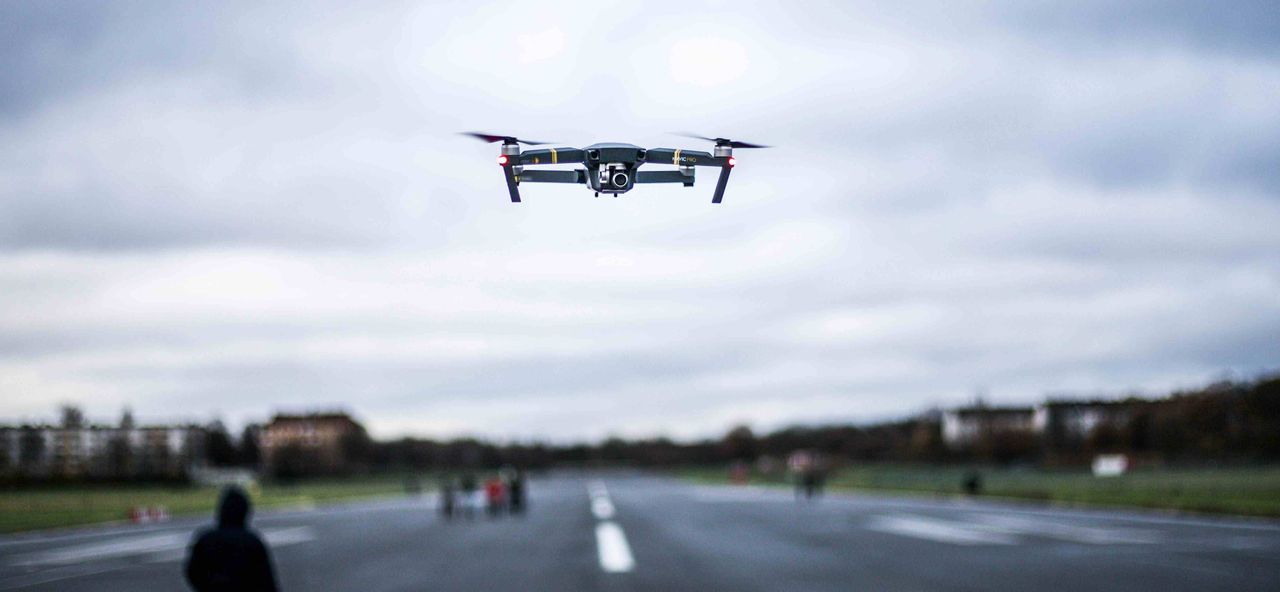

Recently, drones at airports have gone from being a rarity to a recurring theme in European media. For example, unauthorised drones were observed in the airspace at both Oslo Airport and Copenhagen Airport on 22 September, leading to the airports closing air traffic for several hours.
Copenhagen Airport subsequently confirmed that there was no doubt that unauthorised drones were flying over the area and has submitted documentation and video surveillance to the Copenhagen Police and the relevant authorities.
But why do drones cause such major problems for air traffic, and what does it mean for you as a traveller if your flight is delayed due to drones in the airspace?
Why are drones a problem at airports?
Although many people use drones for hobbies or photography, they can create serious safety issues when they get too close to critical infrastructure such as airports or military installations.
A drone can pose a danger to both pilots and aircraft because even a small object can cause extensive damage if it hits an aircraft during take-off or landing. That is why the authorities have very clear rules about where you are allowed to fly.
The general rules are:
You may not fly drones near an airport without special permission.
You may not fly close to a military airfield without special permission.
Flying is prohibited in military areas, protected nature areas and densely populated areas, unless prior permission has been granted.
To fly a drone safely near airports, you must therefore either stay within the specified distances or obtain specific permission – and this always requires a risk assessment.
In other words, it is strictly forbidden to fly near airports without permission, precisely to avoid dangerous situations with other aircraft.
What happened at Oslo Airport?
On 22 September 2025, Oslo Airport Gardermoen was temporarily closed for about three hours due to reports of drones in the airspace. The closure took effect around midnight after pilots and control towers observed drones in the approach area. During this period, both arrivals and departures were temporarily suspended or diverted to other Norwegian airports until the area was declared safe. After approximately three hours, Avinor gradually resumed normal operations. It has not been officially confirmed how many flights were affected, but the incident caused delays and a few cancellations in night-time traffic.
What happened at Copenhagen Airport?
According to Copenhagen Airport, several drones were detected over the area around the runway in Kastrup. The observations lasted for up to four hours, during which time the drones hovered in the airspace.
The airport's security systems, which continuously monitor the airspace, detected the flying objects, and air traffic was immediately shut down. A number of flights had to be diverted to other airports, while passengers in the terminal had to wait.
After the incident, material was passed on to the police, who are now working with telecommunications data, video surveillance and radar data to find out where the drones came from and who the operator was.
Defence Minister Troels Lund Poulsen has also confirmed that there has been drone activity over Denmark and that drones have also been observed over military installations.
Why does the airport close when drones are spotted?
When unauthorised drones are detected in the airspace around an airport, air traffic is immediately halted. This is a requirement of both aviation authorities and EU safety regulations.
The closure is to ensure that no aircraft come near the drone until the area has been checked and is safe again.
At Oslo Airport, this meant that flights were not allowed to take off or land for three hours, and some had to be diverted to nearby airports.
At Copenhagen Airport, this meant that planes had to remain on the ground while arriving flights were diverted to other airports in Denmark and Europe.
Although such closures rarely last more than four hours, the consequences can be felt throughout the day. When the airspace reopens, air traffic must be rebuilt gradually to avoid overloading the runways.
What does this mean for you as a passenger?
If you are affected by a delay or cancellation due to drones, it is natural to ask whether you are entitled to compensation.
According to the EU Air Passenger Regulation (EC 261/2004), there are clear rules: you are entitled to compensation if the airline is responsible for the delay – but not if the cause is beyond its control.
Drones at the airport are considered an extraordinary circumstance because the airline can neither predict nor prevent the incident. This means that, as a rule, you cannot claim financial compensation, even if you have to wait for several hours.
You still have rights
Even if you are not entitled to compensation, you are still entitled to assistance and care services from the airline:
For delays of more than 2 hours, you are entitled to food and drink.
For longer waiting times, you must have access to communication (e.g. telephone or internet).
If you have to stay overnight, the airline must provide hotel accommodation and transport.
For delays of more than 5 hours, you can choose to cancel your trip and get a refund for your ticket or be rebooked on another flight.
If you do not receive the necessary assistance, you can purchase food or a hotel yourself and claim reimbursement later – as long as you keep your receipts.
Can you still get compensation?
Yes, in certain cases. If the airline hasn’t done enough to minimise the delay – for example, by failing to find alternative transport – you may still be entitled to compensation.
Therefore, it is always advisable to have your case assessed. With us, you can check whether you are still entitled to compensation, even if the official reason was a drone sighting.
A growing phenomenon in Europe
Drones at airports are not an isolated Nordic phenomenon. Similar incidents have occurred throughout Europe, including in Munich, Alicante and Brussels.
In Denmark, the Copenhagen Aviation Authority has recorded several sightings of drones and aerial observations in the period around the incident. The police are continuing their investigation and are continuously evaluating the types and extent of drones in Danish airspace.
Although there is still no concrete evidence as to who is behind the drone flights, developments clearly show that drones are increasingly challenging both the safety and operation of airports in Europe.
How can you contribute to safe flying?
Although flying a drone in your spare time may seem harmless, as an operator you have a responsibility to follow the rules.
You must always:
Fly safely and avoid endangering others.
Keep your distance from airports, military installations and densely populated areas.
Seek permission and conduct a risk assessment if you wish to fly closer.
Violation of the rules may result in fines or, in serious cases, criminal consequences.
Summary
Drones at airports pose a growing challenge to flight safety, and recent sightings at Oslo and Copenhagen airports show how seriously the authorities are taking the matter.
Although drones are small, they can have major consequences: airspace closures, diverted flights and delays affecting thousands of passengers.
As a traveller, you are rarely entitled to compensation because drones are considered extraordinary circumstances – but you are still entitled to assistance, meals and information from the airline.
If you are affected by a drone incident, you can always use Refundmore.com to check whether you are entitled to compensation or a refund.
And as a drone pilot: Always remember to fly responsibly, keep your distance and follow the rules – this will help ensure that both Danish airspace and air traffic remain safe for everyone.