
How big can a cabin suitcase be? The complete guide to carry-on luggage
When travelling by plane, there are many things to keep track of: tickets, passports, times – and, last but not least, luggage. One of the most frequently asked questions among air travellers is "How big can a cabin bag be?". The answer depends on the rules of different airlines, and although there is a kind of standard, there can be significant variations from company to company.
In this blog post, you will get an overview of the rules that apply to hand luggage dimensions at different airlines and other relevant hand luggage rules.
Standard dimensions for cabin suitcases and hand luggage
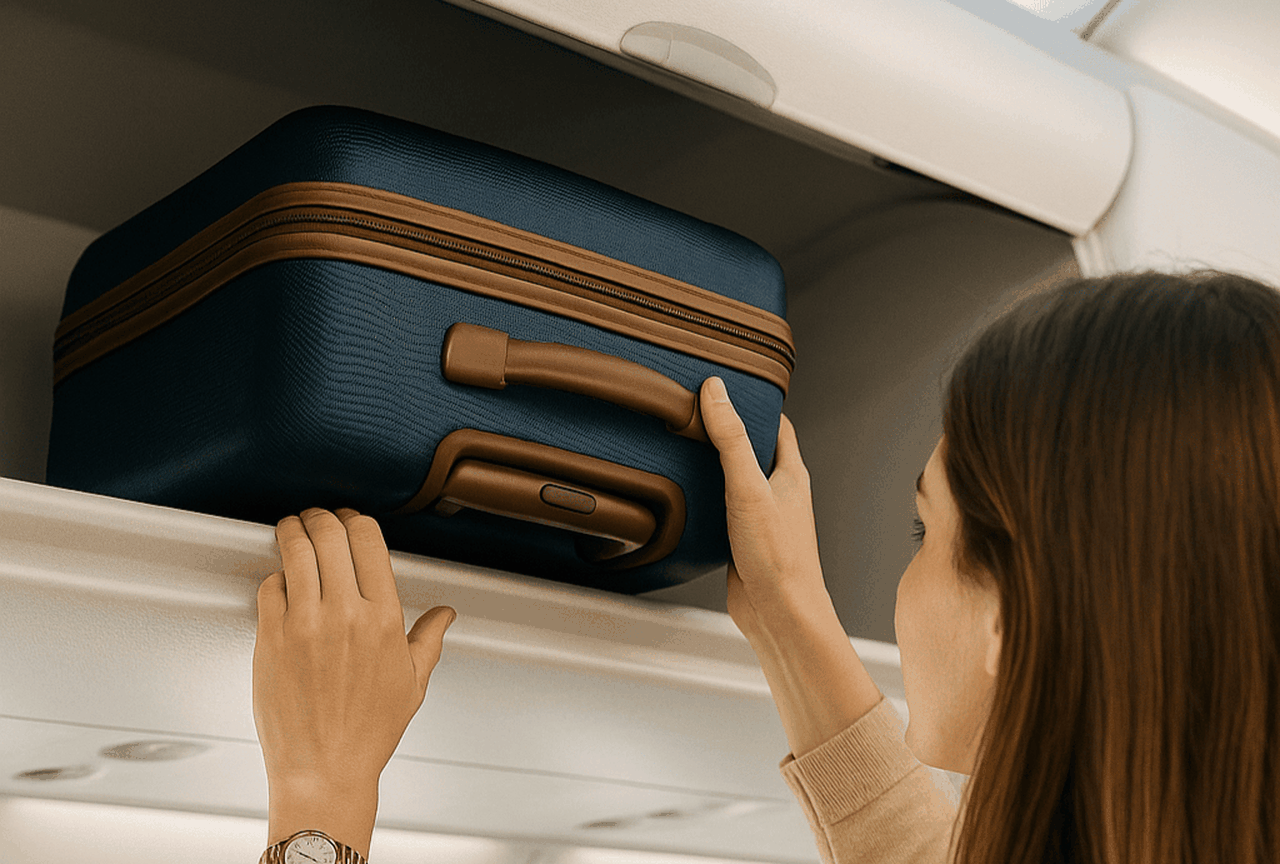
Most airlines allow one cabin bag with maximum dimensions of approximately 55 x 40 x 20 cm. This is often referred to as the industry standard, but it is important to emphasise that rules vary.
It is also important to check whether your ticket type allows you to bring a suitcase on board at all. Most low-cost airlines now only allow a bag that can be placed under the seat in front of you, unless you purchase one of the more expensive tickets or add a cabin suitcase to your booking.
The table below provides an overview of the type and size of hand luggage that some of the most popular airlines allow you to bring on board the aircraft:
Airline | Allowed Cabin Suitcase Size | Is Cabin Suitcase Included In The Cheapest Ticket? |
|---|---|---|
Ryanair | 55x40x20 | ❌ |
SAS | 55x40x23 | ❌ |
Norwegian | 55x40x23 | ❌ |
KLM | 55x35x25 | ❌ |
easyJet | 56x45x25 | ❌ |
British Airways | 56x45x25 | ✅ |
Finnair | 55x40x23 | ❌ |
Standard dimensions for bags under the seat
As shown in the table above, some low-cost airlines such as Ryanair and easyJet only allow one small bag on board unless you pay for priority boarding or extra carry-on luggage.
The permitted dimensions for a bag under the seat are typically around 40x30x15-20 cm, but this varies between airlines. Below, we have compiled the permitted dimensions for bags under the seat for some of the most popular airlines.
Airline | Allowed Size for Under-Seat Bag |
|---|---|
Ryanair | 40x30x20 |
SAS | 40x30x15 |
Norwegian | 40x30x20 |
KLM | 40x30x15 |
easyJet | 45x36x20 |
British Airways | 40x30x15 |
Finnair | 40x30x15 |
Why hand luggage rules vary between airlines
The reason why different airlines have different dimensions and rules is related to the type of aircraft, the airline's service concept and the desire to generate additional revenue. Some airlines use less luggage space as part of their low-cost strategy, while airlines with larger aircraft often allow a little more space for hand luggage at no extra charge.
This also means that airline rules may change, so you should always check the specifications before packing for your trip.
Weight limits – more than just dimensions
Even if your suitcase complies with the permitted dimensions, you may still be stopped if it exceeds the permitted weight. Many airlines operate a weight limit of 7–10 kg for hand luggage, but some airlines allow up to 12 kg or more.
The total weight includes everything in your suitcase, so it's a good idea to weigh your suitcase at home.
When your hand luggage is too large or heavy
If your hand luggage exceeds the permitted weight or dimensions, the staff at the gate may ask you to check it in as checked baggage, which will of course incur a fee. On full flights, your hand luggage may also have to be checked in, even if it complies with the rules. This is particularly common on routes with many passengers and limited space in the cabin. In such cases, there will be no charge.
To avoid problems, you should always pack so that you can quickly remove valuables, electronic equipment and personal belongings from your suitcase if it has to be checked in at the gate.
Checked baggage vs. hand baggage
Checked baggage is ideal if you are travelling with a large suitcase, a lot of clothes or items that you are not allowed to bring on board. It also gives you the freedom to bring liquids without the same restrictions as for hand luggage. However, you must check it in at the airport and collect it after your flight, and you risk your luggage being delayed or lost. On our page about delayed, lost or damaged luggage, we help you understand your rights if you experience problems with your checked-in luggage.
Hand luggage is faster, as you can walk straight through the airport without waiting at the baggage carousel – as long as you comply with the rules of the various airlines.
What can you bring in your hand luggage?
For safety reasons, there are clear rules about what you can bring in your hand luggage. These rules apply to all airlines within the EU:
Liquids: You may only bring liquids in containers of no more than 100 ml.
Multiple containers must be placed in a single transparent, resealable plastic bag with a maximum capacity of 1 litre.
Liquid medicine and baby food are exempt, but must be presented at security.
Electronic devices and laptops must be removed from your bag and placed in a separate tray, so place them strategically in your bag.
Loose batteries and loose lithium batteries may be carried in hand luggage, but not in checked baggage.
Violation of these rules may result in your items being confiscated by the airport.
You can read more about the rules for hand luggage 2025 here.
Medication and special needs
If you need to bring medication with you on your trip, there are special exceptions. You are allowed to bring both solid and liquid medication in the amount you need for your trip. Always bring documentation, such as a prescription, if the amount exceeds the permitted amount for liquids. Read here to find out what other exceptions there are to the 100 ml rule.
All liquid medicine must be presented at security and preferably packed in a transparent, resealable bag for easy inspection.
Rules for e-cigarettes and dangerous goods
E-cigarettes may be carried in your hand luggage, but never in your checked baggage. Loose batteries must always be stored in your hand luggage to minimise the risk of fire.
Dangerous goods – including flammable liquids, gas containers and certain chemicals – are not allowed on board. These rules apply to all airlines and are strictly enforced by the airport.
Hand luggage and shopping at the airport
Once you have passed through security, you can buy items in the airport shops, including duty-free items. These can often be taken on board in addition to your normal hand luggage, but some airlines may still limit the amount for reasons of cabin space.
If you purchase liquids at the airport, they will usually be packed in a sealed, transparent, resealable bag together with the receipt so that they can be taken through security if you have a connecting flight.
Refundmore – your support in case of delays and cancellations
Even when you have all the baggage rules sorted, your journey can still be disrupted. Refundmore helps travellers obtain compensation for delayed and cancelled flights – and in the event of denied boarding due to overbooking.
According to EU Regulation 261/2004, you may be entitled to up to €600 in compensation if your flight is delayed by more than three hours, if it is cancelled at short notice or if you are denied boarding at the gate.
We handle the entire process – from submitting the claim to the airline to paying out the compensation – so you can spend your time on something better than fighting with paperwork.
Conclusion
Knowing the rules for hand luggage makes travelling much smoother. Remember that rules vary between airlines, and you should always double-check the airline's rules before departure.
With the right preparation, you'll avoid surprises at security and at the gate and can focus on enjoying your trip – and if anything goes wrong, Refundmore is ready to help you.
FAQ
Why are there different rules for cabin luggage size?
The different rules for cabin bag sizes may be due to both the airlines' desire to generate extra revenue and the size of the aircraft's overhead compartments.
How much can a cabin bag weigh?
This depends on the airline's rules, but the suitcase must typically weigh between 8-12 kg.
What are the dimensions of a cabin bag?
Typically, a cabin bag should measure 55 x 40 x 23 cm, but this varies between airlines. In the table below, you can see the permitted dimensions for some of the most popular airlines.
How many litres is a cabin suitcase?
The size of a suitcase is usually specified in cm, but assuming that the suitcase is 55 x 40 x 23 cm, it will have a capacity of 50 litres.
How is a cabin suitcase measured?
A cabin suitcase is measured on the outside, as it must fit into the overhead compartment on the plane.