
How many ml can I carry in my hand luggage?
When you're packing your hand luggage for a trip, there are many things to consider: passports, tickets, chargers and maybe a good book. But one question often comes up: How many milliliters can you carry in your hand luggage?
It may seem like a small detail, but it's actually one of the most important rules to know when going through airport security. If you don't follow the rules for liquids in hand luggage, you risk having your products confiscated or being delayed so much that you miss your flight.
In this blog post, you'll find everything you need to know about the rules of liquid in hand luggage explained clearly and simply. We'll cover the rules, the exceptions and give you advice to help you travel without unnecessary obstacles. If you would like to learn more about general rules for hand luggage, you can find them here.
The rules in summary: How many ml you can carry
According to EU security regulations, which apply in all member states and many associated countries, you are only allowed to carry containers with liquids up to 100ml in your hand luggage.
Here are the rules:
Max. 100ml per container: You can only bring liquids in containers of 100ml maximum.
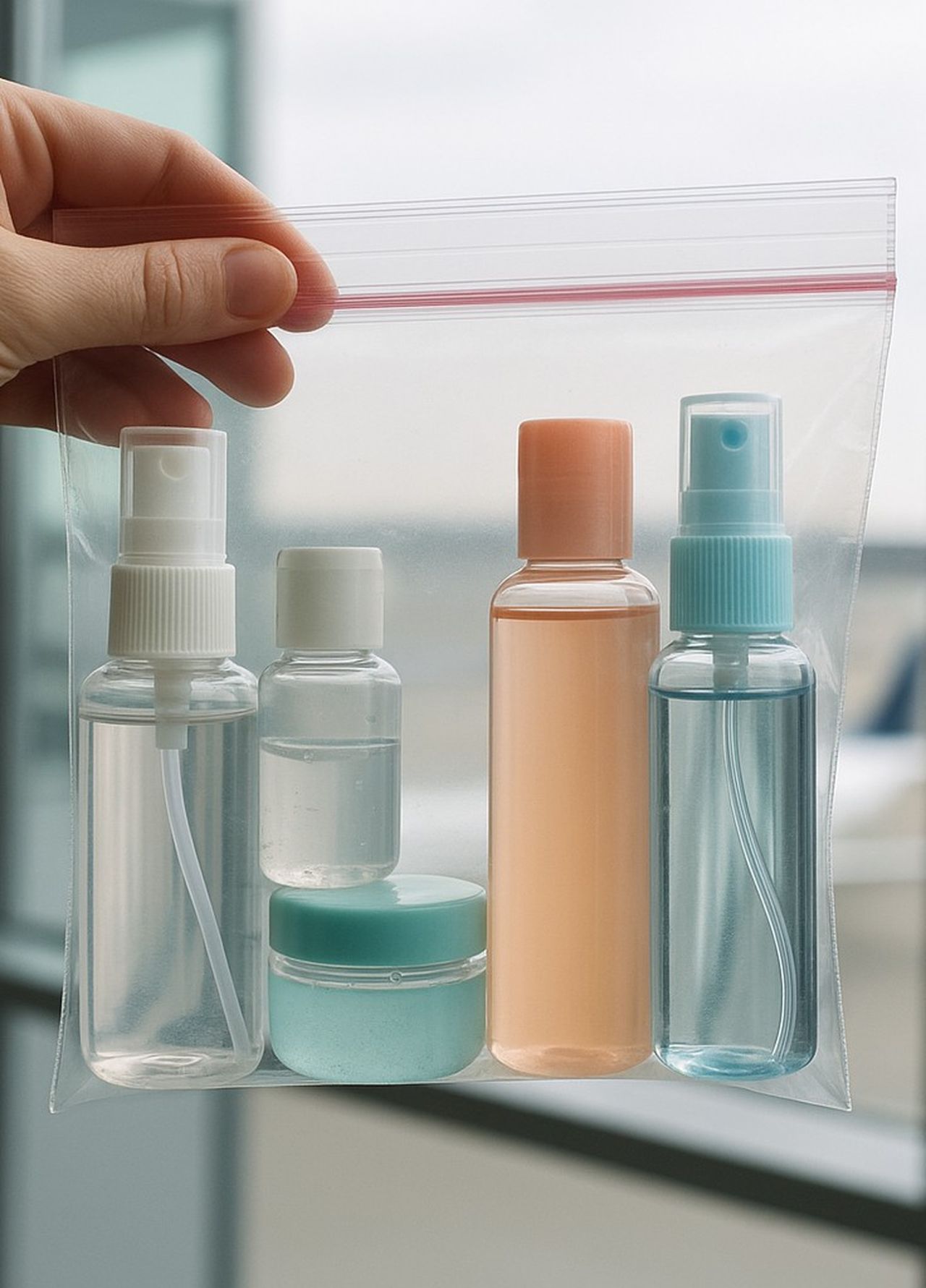
Max. 1 liter in total: All your liquid containers must fit in one transparent and resealable 1-liter bag.
Only one bag per person: And the bag must be able to be closed completely - typically a ziplock bag of about 20 x 20 cm.
This means that you can bring a maximum of 1 litre of liquid in total, but divided into smaller containers of no more than 100 ml each.
It's important to emphasize that it's not the amount of liquid in the container that counts - it's the capacity of the container itself. For example, if you have a 200ml bottle of shampoo that is only half full, it will still be rejected at security because the bottle can hold more than 100ml.
What actually counts as liquid?
It's not always obvious what counts as a liquid according to airport security rules. Here are some examples that are all considered liquids:
Drinks (water, juice, soft drinks, etc.)
Shampoo, conditioner and soap
Lotion and sunscreen
Toothpaste and liquid mouthwash
Perfume and deodorant (incl. roll-on and spray)
Foundation, liquid concealer and mascara
Hair gel and wax
Soups, yoghurt and other semi-liquid foods
Contact lens solution
Liquid medicine (under special rules)
When in doubt, the safest starting point is to ask yourself: "Can it be poured out?" If the answer is yes, then it most likely counts as a liquid.
Exceptions to the 100ml rule
There are some exceptions where you can carry liquids over 100ml in your hand luggage. Here are the most relevant ones:
1. Medicine
You are allowed to bring any liquid medication you need during your flight, even if the container is over 100ml. However, it is recommended that you bring documentation, such as a prescription or doctor's note, and that you inform security if you bring anything out of the norm.
2. Baby food and breast milk
If you are travelling with infants, you can bring baby food, breast milk or formula in quantities larger than 100 ml, even if the baby will not necessarily eat during the flight.
3. Special diets
If you need a liquid diet for health reasons, you are welcome to bring this with you. As with medication, it is recommended to have documentation ready.
Note: Even with the exceptions, you should be prepared to present the liquids in security, where they are typically scanned separately.
Why do these rules exist for liquids?
The strict rules for liquids in hand luggage were introduced in 2006 as part of the EU's common aviation security policy. This followed a planned terrorist attempt to smuggle explosive liquids on board.
Since then, the decision has been made to limit the amount of liquids allowed through security to make it easier to detect potentially dangerous substances and keep all air travelers safe.
How to pack your hand luggage correctly
To avoid stress and confusion at the airport, it's a good idea to pack your hand luggage in a way that complies with the rules - and makes it easy for you to get through security quickly. Here are some tips:
Use 100ml travel containers - they are available in many supermarkets, pharmacies, and online.
Fill your liquids from home - so you know what you're bringing.
Store all liquids together in one transparent, resealable 1-liter plastic bag (typically a ziplock bag).
A little tip: pack the liquid bag at the top of your luggage so you can pick it up quickly at security.
Avoid bringing unnecessary liquids - and consider whether something can be bought at the airport or on arrival instead.
What happens if you break the rules?
If you have a container of liquid exceeding 100ml, it will be confiscated at the security checkpoint, regardless of whether the bottle is empty or almost empty.
The same applies if your liquid bag cannot be closed or if you are traveling with more than one bag.
During busy periods, this can lead to delays and in the worst case scenario, you could miss your flight. That's why it's always worth double-checking your hand luggage before you leave home.
Remember: Rules change at some airports!
Several EU and UK airports (including London City and Schiphol) have begun introducing 3D scanners, which will allow larger volumes of liquids to be carried in the future.
But! The new rules are not yet widely implemented, so you still need to follow the 100ml rule unless you are 100% sure that your departure airport allows otherwise.
What does this have to do with compensation?
You might be thinking: "What do rules about liquids have to do with Refundmore.com?"
At Refundmore.com, our focus is to help travelers understand their rights and get the compensation they are entitled to when their flight is delayed, cancelled or overbooked. But we also know that good planning starts before you arrive at the airport.
By following the rules for liquids and carry-on baggage, you avoid unnecessary delays and stress - and increase the chances of your journey running smoothly.
If your flight is delayed or cancelled, you can always check if you are eligible for compensation - it only takes a few minutes.
FAQ: Frequently asked questions about liquids in hand luggage
How many ml of liquid can I carry in my hand luggage?
Max. 100 ml per container and max. 1 liter in total, packed in one transparent ziplock bag.
Can I bring toothpaste and make-up?
Yes, but both count as liquids and must follow the 100ml rule.
Can I bring a 150ml bottle if it's only half full?
No, it's the maximum volume of the container that counts - not how much is in it.
What about medication?
You can bring liquid medication over 100ml if necessary and documented.
Are the rules the same around the world?
No, but the EU, Norway, Switzerland and many other countries have similar rules. Always check the rules at your airport.
What are the rules for bringing food in hand luggage?
As a general rule, you are allowed to bring food on the plane, but there are some things you need to be aware of, such as whether the food is liquid and therefore subject to the rules for liquids. Read more about the rules for food in hand luggage here.